The Network As
One Computer
A 3-year research effort exploring whether distributed computation, storage, and coordination could be unified through a single consistent type system.
We set out to build a new kind of development environment.
Developers could describe what they wanted in plain English. AI agents would generate the code and infrastructure. Version control, build systems, and orchestration would speak the same language.
We called it Console One. A unified layer for software development.
Fragmented
by Default
Building distributed software today means connecting a lot of separate systems — databases, queues, APIs, deployment tools, orchestration layers. Each one has its own logic, its own state, its own way of failing.
We wanted to see if there was a simpler foundation. One structure that could handle storage, compute, and coordination together — where every change is tracked and the whole system stays in sync.
The Model
- 1
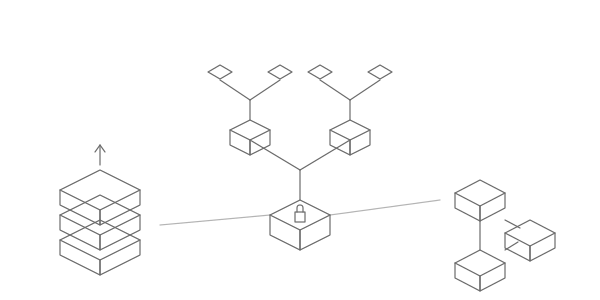
One structure
Data, logic, and permissions all live in the same tree. Everything is defined in one place — if it doesn't fit the schema, it doesn't get in.
- 2
Every change is a commit
Nothing happens without a record. Writes, reads, computations — all logged. Any state can be replayed. Any change can be rolled back.
- 3
No central server
Nodes own parts of the tree and stay in sync. Any machine can join, catch up on history, and participate without asking permission.
- 4
Security is structural
Access control isn't bolted on — it's part of the tree itself. If you don't have the path to something, you can't reach it.
Console One is no longer in active development.
After 3 years of building, we shifted focus to StoryLens. A platform for connecting AI to business tools while keeping data secure.
The work shaped how we think about infrastructure. Some of those ideas are finding their way into StoryLens.
We plan to OS some of the project in 2026. Till then, StoryLens remains the focus.